
- info@inotelelk.com
- Ostim OSB Mah. Turan Çiğdem Cad. No: 7/1 06374 Yenimahalle / Ankara
In facilities that require a critical power supply, such as hospitals, industrial plants, and data centers, selecting the correct IT system insulation monitoring relay is essential to ensure both safety and continuity of operation. In unearthed (IT) power systems, these devices are used to prevent an interruption of the power supply in the event of a first insulation fault. Their selection should therefore take into account key technical parameters such as the system supply voltage, the total network capacitance, and nominal current ratings.
Following device selection, IMD (Insulation Monitoring Device) settings represent one of the most critical stages, as they determine the sensitivity and response characteristics of the monitoring system.
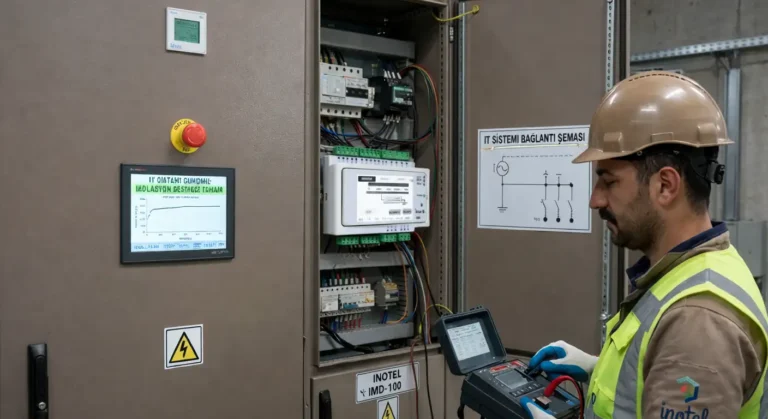
Alarm threshold values, typically specified in kΩ, should be set according to the system’s leakage capacitance. Thresholds that are set too low may result in nuisance alarms, while excessively high thresholds may cause hazardous insulation conditions to go undetected. The device response time and automatic self-test functions should also be optimized to ensure reliable operation.
A properly configured monitoring system provides proactive protection against potential fault scenarios. For example, in the event of a first insulation fault (earth fault), the device immediately generates an alarm while allowing the system to remain in operation. However, if a second insulation fault occurs, a short-circuit condition may develop; therefore, the fault source must be identified and isolated as quickly as possible.
For this reason, correct relay selection and precise IMD settings are essential for maintaining system integrity under all foreseeable fault scenarios, maximizing both personnel safety and continuity of facility operation.
The following environmental conditions may temporarily reduce insulation resistance:
Under these conditions, field insulation resistance values have been observed to temporarily decrease below 20 kΩ.
These factors should be evaluated together.
Solar PV plants include both AC and DC sections.
Therefore, it is important that the selected insulation monitoring device is capable of:
Accurate monitoring of both sides is essential for reliable system operation.
Key criteria to consider when selecting an IMD include:
Solar PV plants are high-electromagnetic-interference environments. Devices with unstable measurement performance may generate nuisance alarms. Measurement stability is therefore a critical selection criterion.
A common approach in solar PV applications is:
A double fault occurs when two different phases (or DC+ and DC-) separately develop short circuits to earth. In this case:
In the event of a phase-to-phase short circuit:
are expected to disconnect the circuit. Early detection of the first insulation fault is therefore critical.
Unintentional earthing may occur in the field as a result of mechanical damage, installation errors, or crushed cables.
In modern solar PV projects, increasing system voltage levels, neutral-free inverter topologies, and varying site conditions have made continuous insulation resistance monitoring essential.
Residual current relays and insulation monitoring devices serve different purposes.
Especially in 800 V – 1000 V PV systems, a properly selected and correctly configured IMD: