Bize Ulaşın

RS485 Communication Line Failure Problem: Protecting RTU and PLC Ports

INTRODUCTION

In industrial facilities, power plants, and distribution networks, RTU and PLC devices are fundamental components of critical communication infrastructure.

However, there is a common problem frequently encountered in the field that often remains unresolved and continues to recur:

RS485 port failures and burnouts

These failures are generally caused by:

  • Lightning effects
  • Ground potential differences
  • Voltage surges
  • Industrial electromagnetic disturbances
  • Long field cable runs

Since RTUs are expensive and critical devices, such failures result in both high costs and prolonged system downtime.

Field Safety · Technical Guide

RS485 port failure is not inevitable.

Explore, step by step, how to protect the most vulnerable communication interfaces of RTUs and PLCs against lightning, ground potential differences, and industrial voltage transients.
2.5 kV Galvanic IsolationModbus Communication ContinuityPreventive Protection
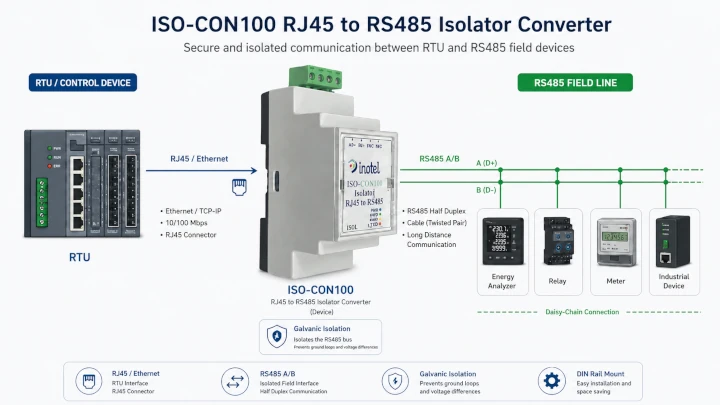
RS485 Field Network DiagramISOCON-100 RJ45 to RS485 isolator converter for RTU field lines
RTU–ISOCON–Field Network Connection Diagram
01 · The Problem

A seemingly minor field fault can cause a major system outage.

In industrial facilities, power plants, and distribution networks, RTUs and PLCs form the core of critical communication infrastructure. Nevertheless, one recurring problem often remains unresolved: RS485 port failures and burnout.

Operational impact: Even if only the communication port of an expensive RTU is damaged, the entire system may be disrupted, resulting in device replacement, on-site service visits, and extended downtime.
ϟ

Lightning Effects

Nearby or direct lightning strikes can generate high-voltage transients in long field cables.

⏚

Ground Potential Difference

Potential differences between separate panels and field locations can be transferred onto the communication line.

↯

Voltage Surges

Switching operations and the start-up of large motors can generate sudden voltage transients.

⌁

Long Cable Effects

Long RS485 cables can pick up electromagnetic interference and conduct it towards connected devices.

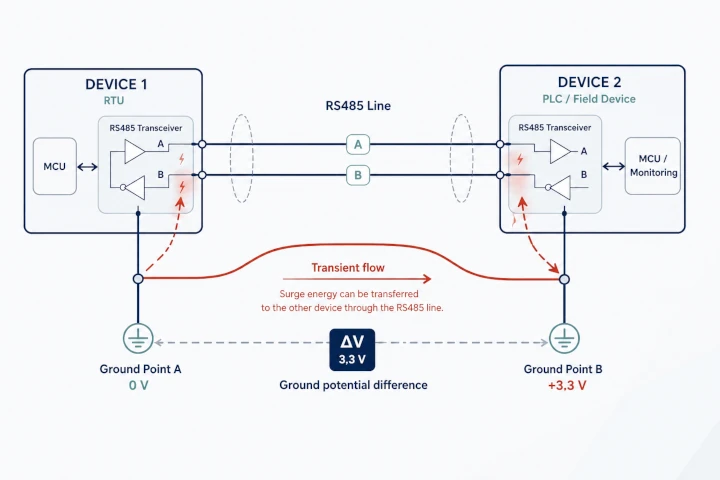
Ground Potential Difference DiagramGround potential difference in an RS485 communication line
02 · Failure Mechanism

Why is RS485 vulnerable?

RS485 uses differential signalling; however, in many devices, the line reference is connected to the internal circuit ground. When long field cables interconnect locations with different ground potentials, surge energy can reach the communication transceiver directly.

  • Communication ports typically operate at 3.3 V or 5 V levels.
  • They are not designed to withstand high-energy transients.
  • Ground transients can enter the device’s internal circuitry through the communication line.
3.3–5 VTypical Port Voltage Level
A / BDifferential Signal Lines
Single PortComponent Most Commonly Damaged
03 · Field Symptoms

How does the fault manifest itself?

SYMPTOM 01

Modbus Communication Is Lost

Devices on the network stop responding, interrupting data transmission and remote monitoring.

SYMPTOM 02

The RTU Resets Intermittently

Surge energy may affect not only the communication port but also the stability of the power supply and processor.

SYMPTOM 03

The Device Becomes Inoperative

Damage to the communication transceiver may cause the entire RTU or PLC to stop operating.

Why Are Conventional Measures Insufficient?

Grounding and surge protection devices are essential, but they cannot replace isolation.

Without galvanic separation between the RS485 line and the RTU’s internal circuitry, an electrical path remains through which transient energy can enter the device.

The long-term solution is to establish an electrical barrier between the communication line and the device.

Improved grounding and appropriate surge protection are integral parts of system design; however, galvanic isolation provides a separate layer of protection.

04 · The Solution

A protective barrier with 2.5 kV galvanic isolation.

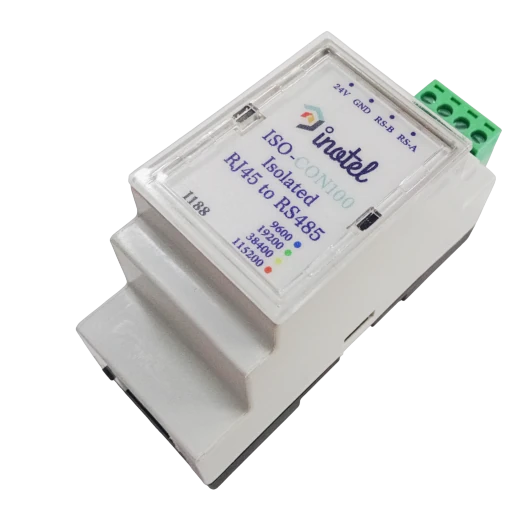
Inotel ISOCON is a communication isolation device designed to electrically isolate the RS485 ports of RTUs, PLCs, and other critical equipment from field cabling.
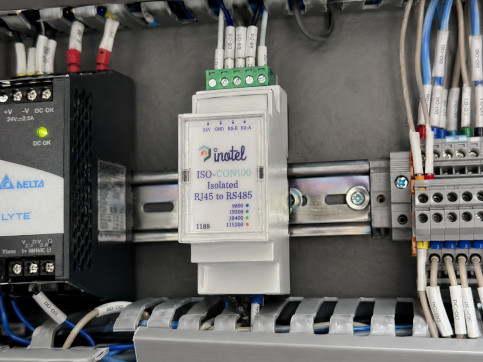
  • Limits the transfer of ground potential differences to the device side.
  • Helps prevent surge and transient energy from reaching the communication transceiver.
  • Supports continuous Modbus communication and enhanced port protection.
ISOCON Product FamilyInotel ISOCON100 and ISOCON101 RS485 galvanic isolator product family
Inotel RJ45–RS485 Converters:
ISOCON101 and ISOCON100
ISOCON101

RS485 → RS485

Isolation2.5 kV
Baud Rate4 Selectable Rates
MountingDIN Rail
Power Supply18–30 V DC
ISOCON100

RJ45 (RS485) → RS485

Isolation2.5 kV
Baud Rate4 Selectable Rates
MountingDIN Rail
Power Supply18–30 V DC

Suitable for direct integration with RTU models equipped with an RJ45 RS485 port.

05 · Operating Principle

Interrupt the path through which surge energy reaches the device.

Connect the Field Line

Connect the long RS485 cable to the field side of the ISOCON.

Provide Galvanic Isolation

The field side and device side are electrically isolated from each other at 2.5 kV.

Limit Transients

Ground transients are prevented from reaching the internal circuitry of the RTU or PLC.

Maintain Communication

Modbus data transmission is maintained while the risk of port failure is reduced.

06 · Critical Applications

Where does galvanic isolation become essential?

⚡

Distribution RTU Systems

Power distribution infrastructures in which multiple field locations communicate with a central control system.

☀

Solar PV SCADA Systems

Communication networks connecting inverters, meters, and peripheral devices across large sites.

≈

Hydroelectric and Wind Power Plants

Power generation sites exposed to significant lightning and electromagnetic disturbances.

⚙

Industrial Facilities

Communication networks exposed to frequent switching operations and the operation of large motors.

↔

Long Modbus Lines

Long-distance cables that interconnect equipment with different ground references.

▦

Multi-Panel Systems

Automation systems that exchange data between multiple field panels.

07 · Preventive Approach

Protection before failure, not an alarm after the event.

ISOCON is not an alarm device. Instead of generating a notification after a fault occurs, it is designed to help prevent the fault by establishing a protective isolation layer between the RS485 line and the critical device.

The right approach: Rather than waiting for an RTU port to fail and then replacing the device, implement preventive RS485 galvanic isolation on long field lines and between devices with different ground references.
2.5 kVGalvanic Isolation Rating

Protection Objectives

RTU port protection · PLC communication protection · Modbus line protection · RS485 surge and transient protection · Isolation against ground potential differences