
- info@inotelelk.com
- Ostim OSB Mah. Turan Çiğdem Cad. No: 7/1 06374 Yenimahalle / Ankara
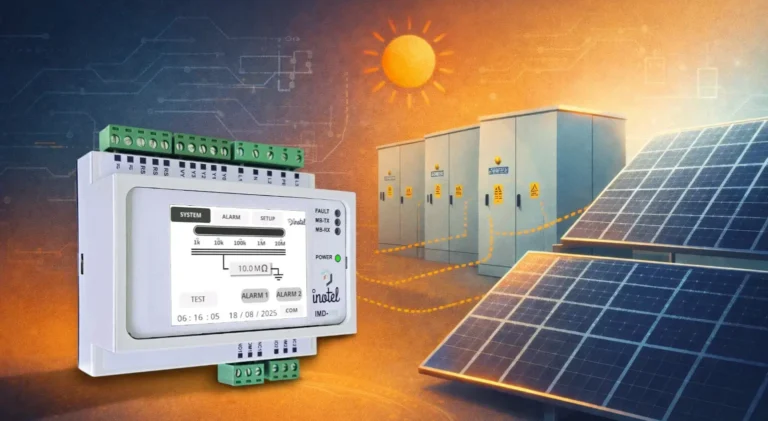
In recent years, increasing system voltages (800V–1000V), evolving inverter topologies and higher operational-safety expectations have made the use of an insulation monitoring device (IMD) increasingly critical in solar power plants. In ungrounded or neutral-free PV systems, an IMD continuously measures insulation resistance between live conductors and earth and generates an alarm when insulation deteriorates, supporting personnel safety, equipment protection and operational continuity.
An insulation monitoring device is a protection device used in IT systems (ungrounded or isolated-from-earth systems) to continuously measure the total insulation resistance between live conductors and earth.
Over the last decade, significant technological changes have occurred in PV systems:
The transition from 400V to 800V has increased capacitive effects and leakage tendencies.
Many large-scale PV plants now use central inverters operating at 800V AC without a neutral conductor.
Modern plants may include kilometres of DC cable and thousands of PV modules. This increases total system capacitance and makes environmental effects more visible in insulation measurements.
Insulation resistance in PV plants is not a fixed value. It is directly influenced by environmental conditions and equipment condition. Main causes include:
Alarm thresholds and device selection should be evaluated according to system voltage, total cable length, system capacitance, inverter topology, environmental conditions and the number of PV modules. For stable AC and DC insulation monitoring, review the Inotel IMD100 Insulation Monitoring Device.