
- info@inotelelk.com
- Ostim OSB Mah. Turan Çiğdem Cad. No: 7/1 06374 Yenimahalle / Ankara
Residual Current Devices (RCDs) and Insulation Monitoring Devices (IMDs) are both used for electrical safety, but their operating principles and intended systems are different. An RCD detects current imbalance and trips the circuit when residual current occurs. An IMD continuously measures insulation resistance in an IT system and generates an early alarm while the system remains in operation.
| Feature | Residual Current Device (RCD) | Insulation Monitoring Device (IMD) |
|---|---|---|
| System type | TN / TT systems | IT systems |
| Measurement principle | Current imbalance | Insulation-resistance measurement |
| Response | Trips and opens the circuit | Generates an alarm |
| DC-component sensitivity | Limited | High |
| Purpose | Electric-shock protection | Insulation-health monitoring |
In many PV plants—especially those with neutral-free, IT-type systems—RCDs may not operate reliably and can cause nuisance tripping. An IMD instead monitors insulation health continuously while the system remains in operation.
Most modern large-scale PV plants using central inverters at 800V AC operate without a neutral conductor.
As a result:
In these configurations, traditional RCD protection is often unreliable. In an IT system, the first earth fault typically does not interrupt operation, but the second fault creates a serious risk.
The IMD detects the first fault early and generates an alarm so it can be investigated before a second fault occurs. If the first fault is not cleared, a second fault may create a phase-to-phase short circuit through earth.
| Feature | Conventional Grid (TN/TT) | PV Plant (Neutral-Free IT System) |
|---|---|---|
| System structure | A neutral conductor is present and the transformer star point is generally earthed. | No neutral conductor is used; the transformer secondary or inverter output is isolated from earth or connected through high impedance. |
| Measurement approach | An RCD detects current imbalance. | An IMD continuously measures insulation resistance to earth. |
| First earth fault | Protection is intended to disconnect the circuit when residual current occurs. | The system may continue operating while the IMD generates an early alarm. |
| Protection device | RCD together with appropriate overcurrent protection. | IMD for insulation monitoring; appropriate AC/DC protection disconnects a short circuit. |
| Primary risk | Electric shock due to direct or indirect contact. | A second earth fault may create a phase-to-phase or DC+ to DC− short circuit through earth. |
| Operational objective | Rapid disconnection when a residual-current fault occurs. | Detect the first fault early and allow planned maintenance without unnecessary shutdown. |
TN/TT systems: RCDs and overcurrent protection provide rapid disconnection.
Neutral-free IT systems: An IMD monitors insulation resistance and alerts operators before a second fault develops.
RCDs are essential in the systems for which they are designed, but capacitive leakage and DC components in large, neutral-free PV networks can affect their performance and may cause nuisance tripping. An IMD monitors insulation health without immediately interrupting production, allowing the first fault to be investigated before a more serious second fault occurs.
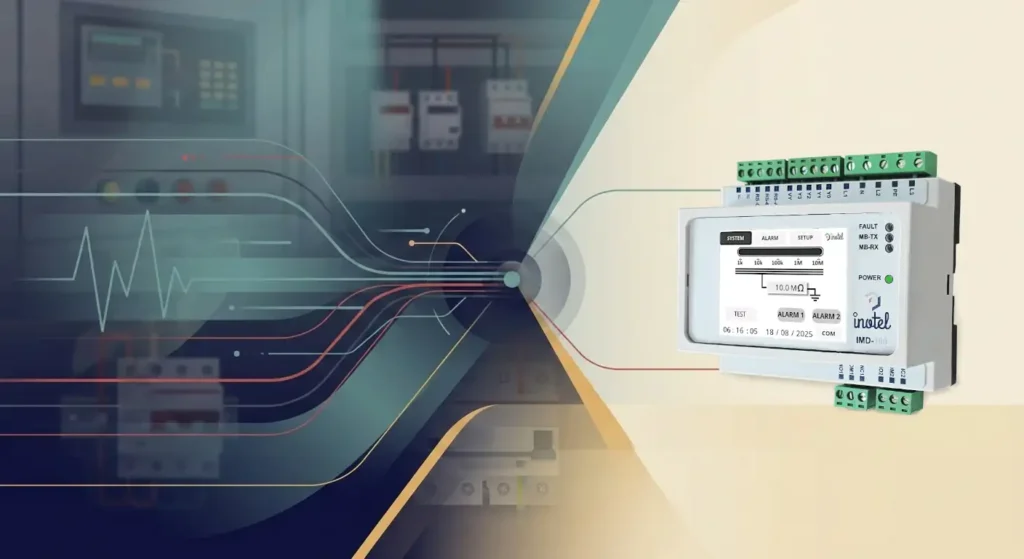
Protection should be selected according to the network topology: an RCD trips on residual current in TN/TT systems, while an IMD continuously monitors insulation resistance and alarms on the first fault in an IT system. For continuous monitoring in neutral-free networks, review the Inotel IMD100 Insulation Monitoring Device.